Closing a Pool in Memphis: What Winterizing Actually Involves
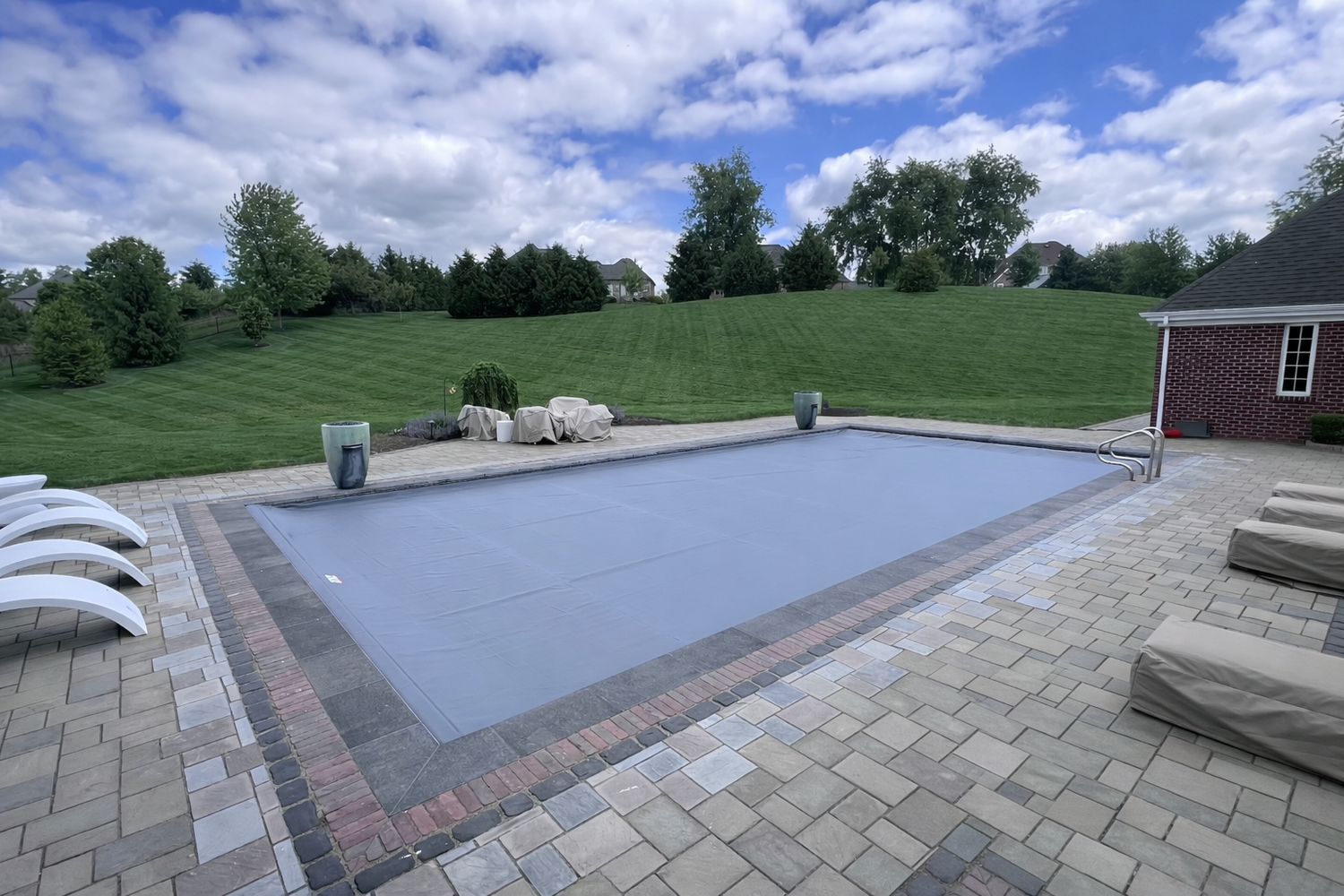
Above: a safety cover closed over a Memphis-area pool. Getting to this point properly is an hour of work at the equipment pad, not ten minutes with a cover.
Memphis does not have a winter the way Chicago has a winter, and that is exactly why so much pool equipment breaks here. Nobody in Minnesota forgets to winterize. In Shelby County you get eight weeks of mild, forgettable weather, then three or four nights in the low twenties, and the pools that were never closed properly are the ones we are quoting pump housings for in April.
Our crews close pools across the Memphis metro every fall, on top of the 160-plus pools we service weekly. Here is what a closing actually includes, when to book it, what it costs, and the one thing we do differently here than the instructions on a box of winterizing chemicals will tell you.
Memphis does not get a winter. It gets about six nights that matter.
Water in a pool does not freeze solid here. Water sitting still in a two-inch PVC return line, a pump housing, a filter body or a heater exchanger freezes just fine on a 19-degree night, and when it expands it cracks whatever it is sitting in. One hard freeze is enough. The December 2022 stretch, when the Mid-South sat below freezing for days, took out equipment pads all over the metro.
So closing a pool in Memphis is not really about ice on the surface. It is about three things:
- Standing water in the equipment and the plumbing on the handful of nights a year that go hard below freezing.
- Four months of chemistry nobody is watching. A pool closed dirty or unbalanced in November is a green pool in March, and the chemicals to recover it cost more than the closing did.
- Leaves. Mid-South oaks drop through December, and debris left to rot on a plaster floor leaves permanent stains.
What a real closing includes
When our crew closes a pool, this is the sequence. If you are comparing quotes, compare them against this list: the cheap closings in this market skip steps three and four, the two that protect your equipment.
- Balance the water first, about a week out. Chemistry moves slowly in cold water. Alkalinity, pH, calcium hardness and stabiliser get set before we close, not on the day, so the water sits balanced all winter instead of etching plaster or scaling it.
- Clean it properly. Brush the walls, vacuum the floor, empty the baskets, clean or backwash the filter. Anything organic left in the pool spends four months breaking down in there.
- Blow out and plug every line. Skimmer, main drain, returns, cleaner line, spa lines, water features. Each line is blown clear with a compressor and then plugged so water cannot creep back in. Non-toxic pool antifreeze goes in the lines that cannot be fully cleared.
- Drain the equipment. Pump housing, filter body, heater, chlorinator, booster pump. Drain plugs come out and go in the pump basket, where they will still be in April. The multiport valve gets set so it cannot hold water.
- Winter chemistry. A shock dose and a winter algaecide sized to the pool volume, circulated before the cover goes on.
- Cover it. Fitted and secured, with the water at the right level underneath it.
The one thing we do differently here: we do not drain your pool
This is the most expensive mistake a Memphis pool owner can make, and it gets made every year by people doing the right thing for the wrong climate.
Do not drain the pool to close it. Our clay soil holds water, the water table in parts of the county sits high, and an empty shell is a boat. Hydrostatic pressure can lift a gunite pool out of the ground – popping it – and that is not a repair, it is a replacement. On a vinyl pool, a liner left empty or very low shrinks in the cold and splits at the seams the moment you refill in spring. On plaster, exposure to air and sun does damage that water never would.
A closed pool here stays full to the middle of the skimmer, or just below the skimmer and returns on a liner pool under a mesh cover that lets rain through. If anyone quotes you a closing that involves draining the pool, that is the end of the conversation.
Close it, or run it through winter? Both are legitimate in Memphis.
Because our winters are mild, Memphis is one of the few markets where you genuinely have a choice. Neither answer is wrong. They cost different money and they give you different things.
Close it. Cheapest for the season: nothing running, no electricity, minimal chemicals. The pool is out of service until spring and you pay for an opening to bring it back. Right for most pools, most years.
Run it with freeze protection. The automation circulates whenever the air drops toward freezing – we set ours to come on below 36 degrees – so no line ever holds still water. The pool stays clear, it is swimmable on a warm February week, and there is no spring recovery. It costs more to run, and it depends entirely on the freeze protection and the power staying on. It is the right call if you use the pool year-round, and it is what we do on heated small pools and spas – our post on cocktail and plunge pools covers how.
The hybrid most of our weekly customers land on: closed properly in November, then eyes on it through the winter – cover checked after storms, water level kept up, chemistry looked at. Four months is a long time for a pool to be nobody’s job.
When to book a closing in Memphis
The trigger is water temperature, not the calendar. Below about 60 degrees algae stops growing fast enough to matter, and that usually lands in the first half of November in Shelby County. Close much earlier and a warm spell will bloom the pool under the cover. Wait much later and you are betting against the first hard freeze, which has arrived as early as the week before Thanksgiving.
Practical note: our closing calendar fills through late October. If your pool is still open, call now rather than after the first freeze warning – by then everyone in the metro is calling too.
What a pool closing costs
We quote a closing on the pool, not off a price list, because the job is not the same on every pool. What moves the number: the size of the pool and its plumbing, how many lines and water features there are, whether a spa shares the equipment pad, and whether the pool was plumbed in a way that lets the lines be blown out cleanly. A standard closing covers the full sequence above, the winter chemicals, and setting the cover you already have. A new safety cover is quoted separately, and so is any repair we find while the water is coming down.
A closing costs less than one cracked pump housing, every time. And if you are already on our weekly service route, your closing is scheduled work rather than a call-out, which is the cheapest way to get it done. Larger seasonal work can go on monthly terms through our financing partners.
What skipping it costs
The spring call we get most often starts with “the pump is making a noise.” A cracked pump housing, a split filter body, a heater exchanger that froze, a cracked skimmer throat – all of them trace back to water that should not have been there in December. Any one of them costs more than the closing that would have prevented it, and in April the part is usually on back-order.
That is before the water itself. A pool that sat uncovered and unbalanced all winter needs a spring recovery that can run into weeks of chemicals and filter runtime. Our guide to the seven repairs Memphis pool owners call us about most has freeze damage on it for a reason, and pool equipment repair in April always costs more than a closing in November.
Covers, briefly
The cover is the half of a closing you look at all winter. A mesh safety cover anchors into the deck, holds a person’s weight and lets rain through – the right default for a Memphis pool with trees over it. A solid cover blocks light as well, but needs a pump on top. An automatic cover holds heat on a pool you run through the winter, and when it is shut it is a safety barrier. Whatever you have, check it after every storm.
What we leave you with
Our techs photograph every visit, and a closing is no different: you get photos of the plugged lines, the drained pad and the covered pool, so in April nobody is guessing about where the plugs went. If we find something on the pad – a weeping union, a pump seal starting to go – you hear about it in November, while it is still a small job.
Book a pool closing
We close pools across Shelby, Tipton and Fayette counties in Tennessee and DeSoto County in Mississippi. Call (901) 755-3000 or send us your pool details and we will come back with a date and a price. Already on our weekly route? Your closing is on the schedule – call if you want it moved up.
Questions we get
Do I have to drain my pool to close it in Memphis?
No, and you should not. Memphis clay and a high water table can lift an empty gunite shell out of the ground, and an empty liner shrinks and splits when it is refilled. A closed pool here stays full to the skimmer, or just below the skimmer and returns on a liner pool under a mesh cover.
Can I close my own pool?
You can do the chemistry and the cover. The part worth paying for is blowing out and plugging the lines and draining the equipment, because it needs a compressor, the right plugs, and knowing which lines a given pool actually has. It is also the part that costs thousands if it is done wrong.
What if a hard freeze is forecast before my closing date?
Call us. In the meantime, run the pump continuously through the freeze – moving water does not freeze in the lines – and do not shut the system off overnight. If your system has freeze protection, confirm it is switched on and that the sensor is not sitting in the sun.
Does a closed pool need anything over winter?
A little. Keep the water level up, pump standing water off a solid cover, clear heavy leaf loads, and look at the chemistry once or twice. Pools that get checked over the winter open clear. Pools that are forgotten open green.
When should I open it again?
Before you need it, not when you need it. Late March or early April in this climate, so the water is clear and the equipment problems are found with weeks to spare instead of the day before a cookout. See pool opening and closing.