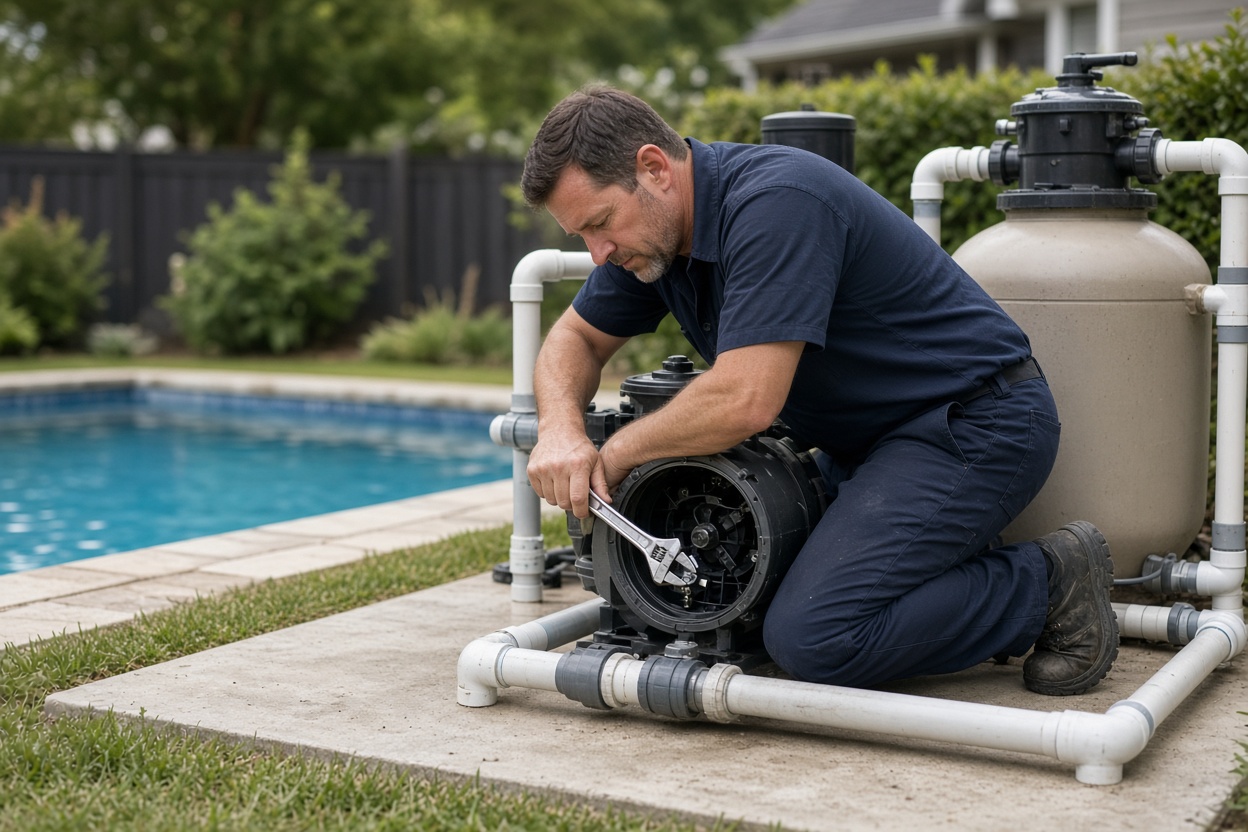
Pool equipment never fails on a convenient day. It fails on the Friday before a July cookout, and it usually gave you warning signs for weeks first. Our techs visit 160+ Memphis-area pools every week, which means we hear the same seven problems on repeat — and we can usually tell what’s wrong from the way an owner describes the sound.
Here are the repairs we’re called about most in the Mid-South, what actually causes them, and the honest line between “fix it today,” “budget for it,” and “stop — you’re about to make it worse.”
1. The pump won’t prime (or is full of air)
What you see: the pump basket won’t fill with water, or churns with bubbles.
What it usually is: a suction-side air leak — a dried-out pump lid O-ring, a loose drain plug, a cracked fitting — or a clogged skimmer line, or the water level has simply dropped below the skimmer mouth.
Why it can’t wait: a pump running dry overheats fast and melts its own seals. That turns a $20 O-ring problem into a motor replacement. If the pump is screaming or the housing is hot, shut it off at the breaker and call.
2. The motor hums but won’t start
What you see: a hum or click, then nothing — or the breaker trips.
What it usually is: a failed start capacitor, a seized shaft, or bad bearings (that’s the loud grinding you’ve been ignoring). Capacitors are a quick, inexpensive fix. Bearings on an older single-speed motor open a real question: repair the old motor, or put that money toward a variable-speed pump that cuts the power bill every month after? We’ll run both numbers with you before touching anything.
3. Filter pressure keeps climbing (or water won’t clear)
What you see: the pressure gauge reads 8–10 PSI over its clean baseline, returns feel weak, water goes dull.
What it usually is: a filter that needs backwashing or a deep clean — or, if backwashing barely helps, sand that has channeled or cartridges at end of life. Memphis pollen season and summer storms load filters hard. Our techs log filter pressure at every service visit specifically to catch this curve before the water turns.
4. Green water after a Memphis storm
What you see: the pool was fine Tuesday; after a storm dumped leaves, debris, and phosphate-rich runoff into 90-degree water, it’s a pond by Friday.
What it actually is: not always an equipment failure — but a storm-green pool that keeps going green usually has an underlying circulation or filtration problem that the storm exposed. Killing the algae is step one; fixing why the pool couldn’t defend itself is the part that keeps it from happening again. (This is exactly the failure mode consistent professional service exists to prevent.)
5. The pool is losing water
What you see: topping off every couple of days.
First, the free test: set a bucket of water on the top step, mark both levels, wait 24 hours with the pump running. If the pool dropped noticeably more than the bucket, it’s a leak, not evaporation. (A quarter inch a day is normal in a Mid-South summer.)
What it usually is: a skimmer throat separation, a fitting, a light niche, or underground plumbing. Leaks never get cheaper by waiting — water escaping under the deck undermines exactly the concrete you least want to replace.
6. Salt system says “check cell” (or chlorine output died)
What it usually is: a scaled-up salt cell that needs cleaning, low salt after heavy rain dilution, or a cell that’s reached end of life (they’re consumables — typically 3–7 years). One Memphis-specific note: cold snaps shut salt cells down by design, so an early-spring “no chlorine” panic is often just water temperature.
7. Freeze damage (the February special)
What you see: a hard freeze hits the Mid-South, and the first warm week our phones fill with cracked pump housings, split PVC, and burst filter valves.
The honest truth: this is the most preventable repair on this list. Freeze protection that actually works — and a proper winterization or opening/closing service — costs a fraction of replacing an equipment pad. If your equipment ran through the last freeze without protection, have it pressure-checked before summer, not during it.
Repair or replace? Our rule of thumb
We use a simple test: if the repair costs more than half the price of new equipment, or it’s the second major repair on the same unit, replace it — and on pumps, replace forward: today’s variable-speed pumps typically pay their own way in energy savings within a couple of seasons. If a $30 capacitor or an O-ring solves it, we say that too. You’ll always get the actual diagnosis with the numbers, not a sales pitch — same-week service across the Memphis metro and North Mississippi.
Pool repair FAQs
How much does pool pump repair cost in Memphis?
Small parts (capacitors, O-rings, gaskets) usually land well under $200 installed. Motor or full pump replacement runs from several hundred dollars to $1,500+ for a quality variable-speed unit. We quote before we work, always.
Why does my breaker trip when the pool pump starts?
Commonly a shorted motor winding, water intrusion in the wiring, or a seized pump drawing locked-rotor current. Stop resetting it repeatedly — that’s how small electrical faults become fires. This one’s a call-us problem.
Can I keep swimming while equipment is broken?
A day or two without circulation in mild weather is survivable. In a Memphis July, an unfiltered pool starts turning in 48–72 hours — get on the schedule fast and keep chlorine in the water in the meantime.
Do you repair equipment you didn’t install?
Yes — we repair all major residential brands, whether or not we’ve ever seen the pool before.
Something not working? Call American Pool Techs at (901) 755-3000, tell us what you’re seeing (or the noise it’s making — seriously, it helps), and we’ll get a tech out. More on our pool equipment repair services, or request a free consultation.