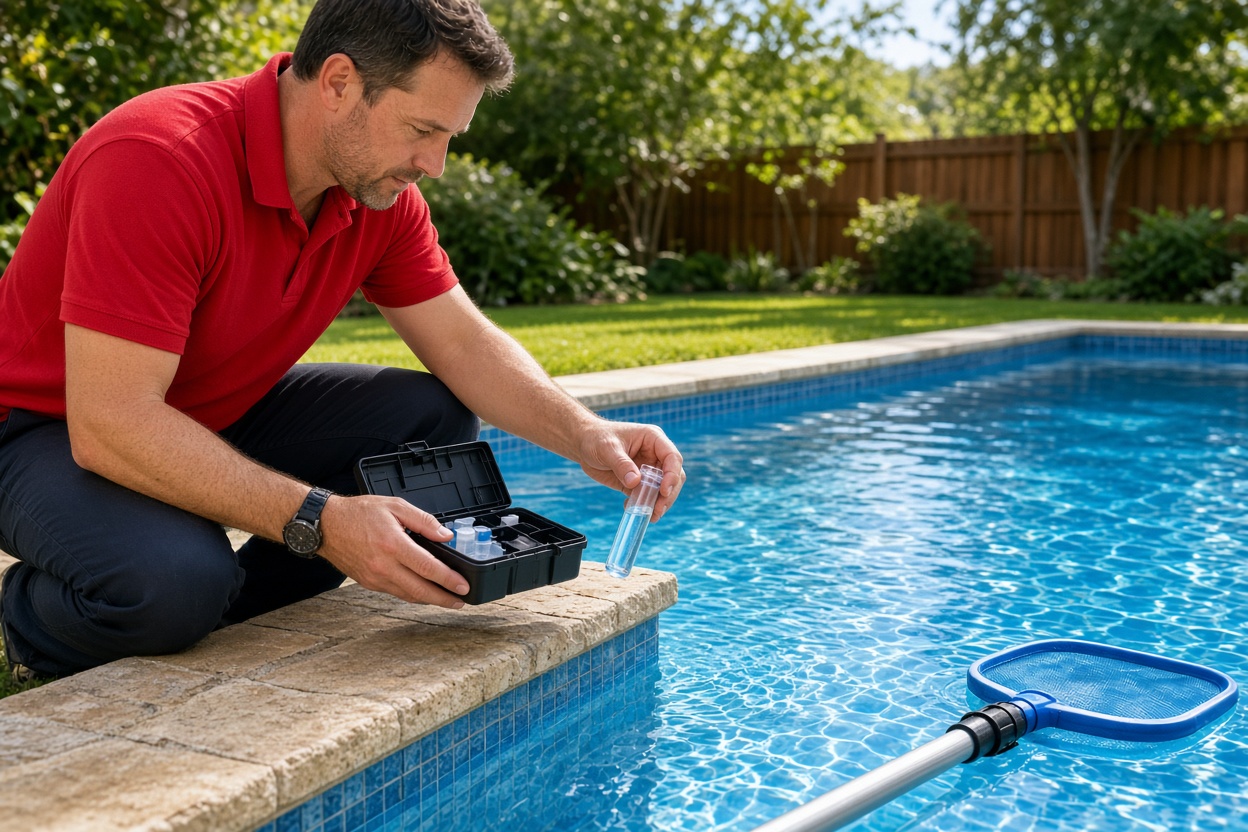
“So… what do you actually do when you’re here?” Fair question — from the kitchen window, pool service can look like fifteen minutes of netting leaves. But there’s a reason a professionally serviced pool stays blue through a Memphis August while the neighbor’s turns green every other week, and it isn’t the net.
Our techs complete a full written work order at every one of the 160+ Mid-South pools we service weekly — every reading logged, every chemical measured, photos taken before we leave. Here’s that checklist, item by item, so you know exactly what professional pool service should include (whoever you hire to do it).
First 60 seconds: water level and a walk-around
Before anything else: is the water level right? Too low and the skimmer sucks air (that’s how pumps burn up); too high and the skimmer can’t skim. We note the level on arrival and where we left it, and we eyeball the pool and pad for anything that changed since last week — a new stain, a wet spot by the equipment, a fence gate left open. Catching problems at “huh, that’s new” is the whole game.
The 8-point water test
This is the part you can’t see from the window, and it’s the part that matters most. Every visit, we test and log:
- Free chlorine — the sanitizer actually protecting swimmers right now
- Total chlorine — reveals spent chlorine (chloramines: the “pool smell” and red eyes)
- pH — controls comfort, equipment corrosion, and whether the chlorine even works
- Total alkalinity — the buffer that keeps pH from bouncing
- Stabilizer (cyanuric acid) — the “sunscreen” your chlorine needs in Memphis sun; too little and chlorine burns off by lunch, too much and it stops killing algae
- Calcium hardness — too low etches plaster, too high scales it
- Salt — on salt pools, the generator only works in the right range
- Phosphates — algae food, washed in by every Memphis storm
Why so many numbers? Because they interact. Chlorine at a perfect 3 ppm does nothing useful if pH has drifted to 8.2. High stabilizer explains “I keep adding chlorine and it’s still green” more often than anything else. One number means nothing; eight numbers weekly, trended over time, means your water is actually under control.
Dosing — measured, logged, and itemized
Based on those readings, the tech adds exactly what the water needs — tabs, shock, acid, alkalinity, stabilizer — and logs each amount on the work order. You should never accept “added some chemicals” from any pool company. Measured dosing is why serviced pools don’t yo-yo between over-bleached and green.
The physical clean
Yes, this part too: skim the surface, brush walls and steps (algae starts in the spots brushing reaches and circulation doesn’t), vacuum as needed, and empty every basket — skimmers and pump. In our fall leaf drop, baskets alone can be half the visit.
Equipment check, graded not glanced
Our work order grades each item — skimmers, automatic cleaner, finger screen, vacuum, brush condition, pump basket, and the filter — on how much debris load it’s carrying, and records filter pressure on arrival and after any backwash. That running log is an early-warning system: creeping pressure means the filter’s struggling before the water clouds; a pump basket that’s suddenly always full means something changed in the yard. When we spot a real problem, it goes on the report for repair — before it’s a swim-cancelling failure.
Photos and a report — proof, not promises
Before leaving, the tech photographs the pool and sends the completed work order in. Ask any company you’re considering one question: “Will I be able to see what was done at each visit?” If the answer is a shrug, keep looking. Documentation is the difference between a service company and a guy with a net.
What service doesn’t replace
Honest scope note: routine service keeps a healthy pool healthy. It doesn’t substitute for seasonal work — proper openings, closings, and winterization protect equipment through Mid-South freezes — and it can’t out-clean failing equipment or a surface at end of life (see our guide to pool renovation in Memphis). What weekly eyes on your pool do guarantee is that when something is heading wrong, you hear about it early, with photos, while it’s still a small fix.
Pool service FAQs
How often does a pool need professional service in Memphis?
Weekly, during swim season especially. Chlorine demand in 90-degree sun is relentless, and storms reload the water with debris and phosphates. Every-other-week service in a Memphis summer is how pools end up green by the missed week’s Friday.
Can’t I just maintain it myself?
Absolutely — plenty of owners do, with a good test kit and a consistent routine. The owners who call us are usually the ones done spending Saturday mornings on it, or tired of the swing between crystal clear and swamp. Either way, insist on the checklist above — from yourself or from us.
What should pool service cost?
Mid-South weekly service typically runs in the $50–$80/week range depending on pool size, trees, and whether chemicals are included or billed as used. Be wary of prices that only work if the tech skips the testing — that’s the part that keeps the water safe.
Do you service pools in Mississippi?
Yes — our routes cover the Memphis metro including Shelby, Tipton, and Fayette counties in Tennessee, and DeSoto County, Mississippi (Southaven, Olive Branch, Hernando, Nesbit).
Want your weeks back? Call American Pool Techs at (901) 755-3000 or request a free consultation, and see what documented, every-single-week pool service feels like.