What an Inground Pool Costs in Memphis
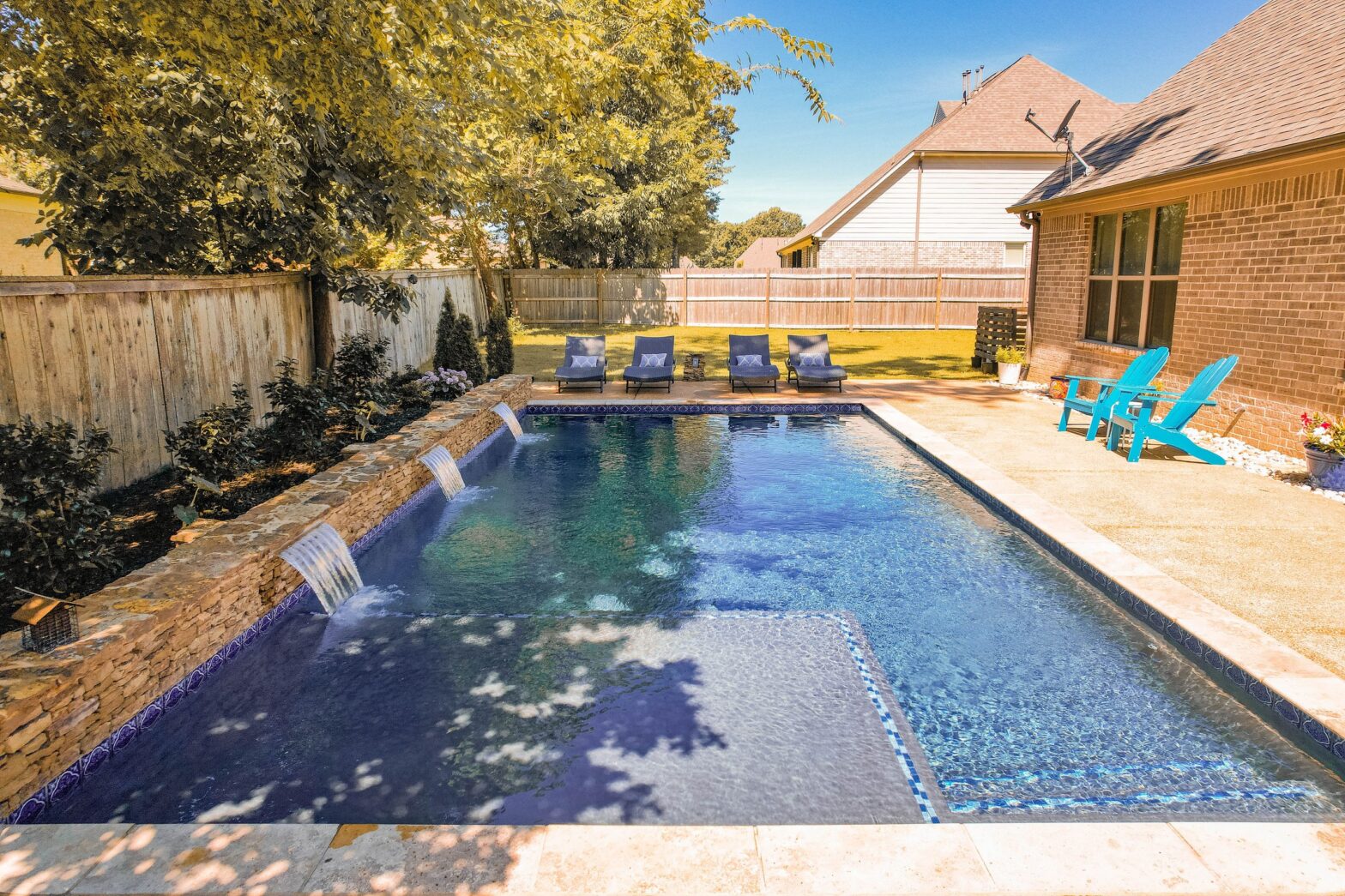
Above: an aerial of a gunite pool with a water wall and tanning ledge we built in Memphis. The pool is only part of what you see – the deck and equipment are the rest, which is where budgets move.
Search “how much does an inground pool cost” and you will get a national average that is useless in Shelby County. It is averaged across markets with sandy soil, flat lots, one permit office and a twelve-month build season. We have clay that swells and shrinks, a water table that sits high in parts of the county, four permit jurisdictions inside the metro, and a lot of 1960s neighbourhoods where the side yard is narrower than an excavator.
We have been building and servicing pools here since 2006, and we do not print prices – every one of these builds is a slightly different job, and the number depends on things we have to come and look at. What we can tell you is how pool pricing works here: what each of the three build types gets you, what is inside the quoted number, what is not, and the six local things that move it. The figure for your own yard comes from a site visit, and it is free.
The three ways to build, and what each one gets you
Gunite (sprayed concrete)
A steel cage, sprayed concrete, then tile, coping and an interior finish. Any shape, any depth, any feature – a tanning ledge, a raised spa wall, a vanishing edge. It is most of what we build, and it is what goes in on tight city lots, because the concrete is pumped in through a hose rather than lifted in by crane.
Where it sits: the most expensive of the three to build, and the only one that can be any shape you can draw. The shell lasts decades; the interior finish is the wear item, resurfaced every 7 to 12 years here depending on how well the water is kept. That is a real part of owning a gunite pool, not a surprise – our post on renovation and resurfacing covers what the work involves.
Fiberglass
A finished shell made at a factory, trucked in and set in the hole with a crane. The surface is smooth and non-porous, so it holds less algae and uses fewer chemicals, and the shell goes in a single day. The catch is access and choice: a crane needs a path to the hole, and you pick from the shapes the manufacturer makes.
Where it sits: usually between a liner pool and gunite to build, and the cheapest of the three to own. Fiberglass wins in the decade after the build, not the build itself: no resurfacing, less chemical use.
Vinyl liner
Steel or polymer wall panels with a vinyl liner fitted inside. The lowest price to get in the water, and the reason most 1990s Memphis pools are liner pools.
Where it sits: the lowest price of the three to get in the water, with a replacement built into the plan. A liner is a wear item on a cycle of years, and replacing it is scheduled maintenance, not a repair – so the cheapest pool to build is not the cheapest one to own over twenty years.
If you are still choosing, our comparison of gunite, vinyl and fiberglass pools in Memphis goes through the trade-offs properly, and the gallery shows what each one looks like finished.
What is in the number, and what is not
This is where quotes stop being comparable. Two bids on the same pool can be far apart and both be honest, because one of them includes a deck and the other does not. When you get our proposal, this is what the base price covers:
- Layout, engineering and the permit for your jurisdiction
- Excavation and hauling the spoil off your property
- Steel, plumbing runs and the shell (gunite, fiberglass or wall panels and liner)
- Tile, coping and the interior finish
- The equipment pad: variable-speed pump, filter, valves, and the electrical bonding that makes the whole thing safe
- A standard deck allowance, with the square footage written into your proposal so you can see where the included deck stops
- Start-up: the first fill, the chemistry, and teaching you the system
And what is not in it, which is the part that surprises people:
- Deck beyond the allowance, and any upgrade from broom-finish concrete to pavers or travertine
- Fencing to code – Tennessee requires a barrier, and it is not optional
- Landscaping repair. Heavy equipment crosses your lawn. We are careful; it still needs sod.
- Utility trenching if the gas line or an electrical subpanel has to reach the pad
- Water to fill it, and the first year of chemicals and service
- Heater, automation, salt system, water features, lighting beyond the standard – all real options, none assumed
- Outdoor living: a pavilion, an outdoor kitchen, a fire feature. We build those; they are their own line.
Six things that move a Memphis pool price
- Clay soil. Mid-South clay does not hold a clean vertical cut the way sand does, so an overdig and extra spoil haul-off are normal here, and a wet spring makes both worse. It is also why we engineer for soil movement rather than hoping.
- The water table. In the low parts of the county and near the river bottoms, groundwater reaches the excavation. That means dewatering during the build and a hydrostatic relief valve in the floor so the shell cannot be lifted later. Real cost, and not negotiable.
- Access. If an excavator cannot get through the side yard, we bring smaller equipment and move more dirt by hand, and that is labour. If a fiberglass shell cannot reach the hole on a crane, the answer is gunite. We tell you which at the site visit, not on the invoice.
- Which jurisdiction you are in. The City of Memphis, unincorporated Shelby County, Germantown, Collierville, Bartlett and DeSoto County in Mississippi each have their own permit process, setbacks and barrier requirements. Setbacks decide what size pool fits before anyone draws anything; we pull the numbers for your address first.
- Deck square footage. This is where pool budgets actually get away from people. The pool is a fixed shape; the patio around it is where you will spend your evenings, and it grows during planning. Decide the deck early, with a number on it.
- Equipment choices. A variable-speed pump costs more up front and pays for itself in electricity. A gas heater and a heat pump do different jobs in this climate. Automation, salt, colour LED – each is a real decision with a real number, and worth making deliberately rather than at the end.
What a pool costs to run, and what drives each part
The build price gets all the attention and the running cost gets almost none. Here is the whole list, and what decides how big each one is:
- Weekly service. Pool size, and how much shade and tree litter it takes. Our weekly service page has what a visit includes.
- Chemicals. Lower on a fiberglass or salt pool, and lower on water kept in balance than on water that swings.
- Electricity. Almost entirely the pump. A variable-speed runs for a fraction of a single-speed, which is why we fit them as standard.
- Gas, if you heat it. How warm you want it and how late you swim, not the size of the heater.
- Opening and closing. See our post on closing a pool in Memphis.
- Insurance and property tax. Call your agent before you sign. A pool usually moves both, a little.
At the site visit we put real numbers against each of those, for your pool rather than a typical one.
Where to save, and where not to
Honest answer from the service side, which is the side that sees how pools age.
Save here: phase the deck and add to it next year. Choose broom-finish concrete now and pavers later. Fewer water features. Standard lighting instead of a fixture in every wall. A smaller pool – our post on cocktail and plunge pools covers how much pool people actually use.
Do not save here: the shell and the steel, the plumbing size, the electrical bonding, the equipment pad, and the interior finish. Those are the things that are either expensive or impossible to fix later, and they are exactly what gets cut by a bid that comes in suspiciously low. We service pools other people built – every week, 160-plus of them – so we know which corners show up five years in.
Financing, and when to sign for a spring pool
Most of our clients finance part of the build, and the monthly number tends to be lower than people expect; terms are on our pool financing page. On timing: a build is a matter of weeks from contract to swimming, weather permitting, and you get a dated schedule with your quote. The spring calendar fills over the winter, so if you want to swim in your own pool next summer, now is the time to be having this conversation. Fall and winter are when we do our best planning work, because nobody is in a hurry.
Get a real number for your yard
A site visit takes about an hour. We measure, check your setbacks, soil and access, and come back with a drawn plan and a price that includes what it says it includes. No charge, no pressure. Call (901) 755-3000 or book a free consultation.
Questions we get
So what does an inground pool cost in Memphis, really?
We will tell you at your yard, and not before – anyone who hands you a number without seeing it is guessing, and the guess will be wrong in the direction that wins the job. Call (901) 755-3000 and you will get a real one.
Is a small pool much cheaper than a big one?
Less than you would hope. Excavation, plumbing, the equipment pad, electrical, permits and the deck cost about the same whether the hole is 16 feet long or 32. The shell and the finish scale down; the rest does not.
Why is a Memphis quote higher than the national average I read?
Clay soil, groundwater, access on older lots and four different permit jurisdictions. The national figure is averaged over markets that have none of those.
Does a pool add value to a Memphis house?
A well-built, well-kept pool makes a backyard that sells. It is not an investment that returns its cost, and nobody should build one as a financial decision. Build it because you will use it.
How long does a build take?
Weeks rather than days, and the weather decides a lot of it. The permit, the shell cure and the deck take roughly the same time on any size pool, so a small pool is not a short project. You get a dated schedule with the quote rather than a guess from us now.
Can I finance the whole thing?
Often, yes, subject to the lender. See pool financing, and ask us at the site visit – we will tell you what our clients are actually being approved for.